
Why it exists
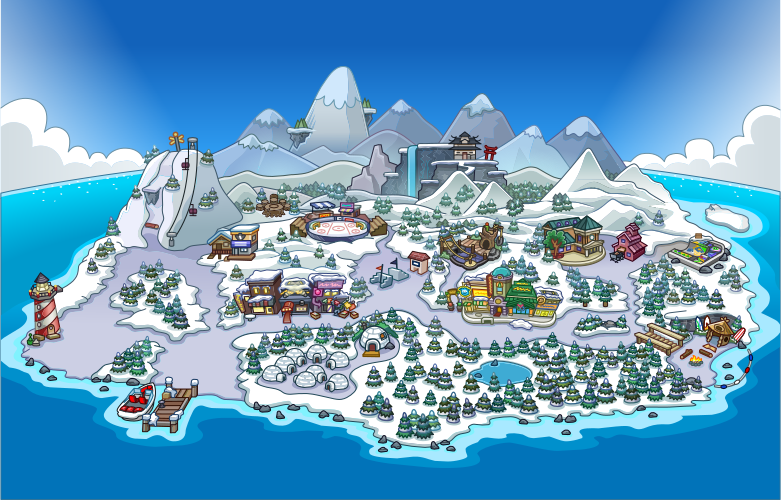
Club Penguin was a big part of many childhoods, and it closed in 2017 along with the Flash technology it was built on. This free, unofficial, educational fan project keeps the game as it was in 2017 playable in today's browsers, to preserve it and to show how a Flash-era online game actually worked.
It is not affiliated with, endorsed by, or sponsored by Disney, and it never makes money: no ads, no payments, no memberships for sale.
Curious about the original? Read what Club Penguin was.
How it works
- The original game. Your browser runs the game's own 2017 files, unchanged.
- Ruffle is an open-source Flash Player emulator, written in Rust and running as WebAssembly, so those files play without Flash.
- Houdini is an open-source Club Penguin server that speaks the game's own network language: rooms, chat, friends, igloos, puffles and minigames.
- A small bridge carries the game's connection over secure WebSockets, since browsers can't open the raw connections Flash used.
Credits
This island stands on the shoulders of a lot of generous people:
- The original Club Penguin team, who made the game.
- Ruffle and its contributors (MIT / Apache 2.0).
- Solero: the Houdini server and the vanilla-media archive of the original game files.
- The Club Penguin wiki and archive communities, who preserved so much of the island's history.
- Fonts: Lilita One, Fredoka, Nunito Sans and Bangers, under the SIL Open Font License 1.1 (served from this site; Lilita One is served as a renamed subset).
Contact
- Quick answers first: Questions and answers
- General questions: contact@clubpenguins.lol
- Reporting a player: abuse@clubpenguins.lol
- Rights holders: dmca@clubpenguins.lol (see copyright and takedown)
- Security problems: security@clubpenguins.lol